
#275: Dispatch from the tunnel

In the fall of 2023, during the first weeks of Sunny’s life, I developed the unfortunate habit of spilling my water bottle on my and Avi’s bed. I’d fill the bottle in the kitchen, screw the top on halfway, then toss it on our bed, where the water would leak and pool on our duvet. I’d never done this before. We joked about it all the time, because it made me so mad—one square foot of drenched bed is a terrible thing —and yet I continued to do it. We were mystified as to how I could repeat such a specific mistake so many times. The habit petered out around a few months postpartum, but not for good: When Sunny was 18 months old, my last half-open water bottle doused my laptop so thoroughly it needed to be replaced. Then the spell was finally broken.
It’s easy to diagnose now. I was so consumed by thoughts of what needed to be done that tasks I formerly thought of as one single act—screwing the lid closed on my water bottle—were split into multiple steps: screw enough so that the bottle wasn’t exposed to the open air, attend to other more urgent tasks, then return to the bottle to finish screwing so that it might be safely thrown on the bed. Of course, in my state of extreme mental and physical exhaustion, I often forgot about the last part.
I’ve been thinking about that era of singular mental disarray as I anticipate returning to it in three months, or have perhaps already arrived. Maybe disarray is the wrong word; in a sense I’d never been more focused in my life. This is one of the paradoxes of parenthood—that you can spin so many plates and achieve, in the cumulative and tangible sense, so little. I recently saw a video of a woman brushing her teeth and eating an Oreo at the same time. “What it’s like to clean your house when you have a toddler,” the caption read. That’s the sort of thing I’m talking about. In the year I spent caring for an infant, the demands on my psyche were even more acute: Any psychological digression from motherhood felt like a triumph.
During my second pregnancy, I’ve returned to this narrow frame. The shift is hormonal, obviously, but also practical, spiritual. To say that it’s occurred against my will isn’t to say that I haven’t enjoyed it at times. In the first days of my pregnancy, I was surprised to feel a dim satisfaction at the opportunity to turn inward again. In my second trimester, I nested so zealously I sometimes worried I’d lost touch with reality. But as I enter my third trimester, my unrelenting domestic focus has wrought a certain shame. I feel out of the loop socially, culturally, professionally. And out of ideas.
When I told my friend Tavi about this at dinner the other night—lamenting that my only essay pitches concerned motherhood, which people only want so much of, and that most of my attention seemed to funnel involuntarily toward (how dare it!) my body and my people and this precise moment in my life—she asked whether I’d considered exploring that. What would it feel like to consent to the frame this pregnancy was imposing, rather than resenting it? Could I go deeper instead of struggling to go wider? She suggested Rachel Aviv’s new essay collection on mothers and daughters, You Won’t Get Free of It, and I bought it the next day.
In the book’s introduction, which I read yesterday, with a creative interest I’ve struggled to muster in recent months, Aviv quotes an entry from her mother’s diary, written when Aviv’s older sister Sari was two years old: “My real life, my family, began to take precedence over my imagined artistic life. … Sari is my life. Everything she is and does is my life.” When Aviv herself was first pregnant at 33, she feared this very “rupture in values and commitments.” Although she couldn’t quite explain why: “I remember a friend pointing out that he did not consider me especially happy. Why then was I so intent on staying the same? I had no answer.”
You Won’t Get Free of It is a collection of essays concerning mothers and daughters that Aviv originally wrote for The New Yorker, when she felt “existentially” like a daughter, which she has now revisited upon the acquisition of her new vantage point as a mother. The book is, among other things, her attempt to “redress what I saw as a kind of imbalance, a deficit of curiosity about the mother half of the couple.” I don’t know whether Tavi understood the double-resonance of her suggestion—to go deeper into my mother frame by reading about another woman going deeper into her mother frame—but it was as apt as the title of the book.
Last week, while reviewing questions in my Dear Baby submission form, I bristled at two queries from pregnant readers who feared losing touch with their pre-kid lives, values, and concerns. They were gripped by the same anxiety described by Aviv. Would their friends still invite them to parties, on trips? They didn’t want to be mistaken for washed up! Normally I enjoy these questions, so when I cringed, I reasoned I’d become jaded: Three years after wringing my hands over the same fears, I now knew “the truth”—that your pre-kid life, values, and concerns weren’t that important, and that everyone’s insistence that they were was precisely what made modern parenthood in America so much harder than it needed to be. What was so wrong with committing to motherhood? Was it really so awful a fate?
But my reaction merely highlighted a bruise. On some level, I realized, I still shared these letter writers’ fears. My mother frame just happened to cast them in a different light. Whereas I once saw these preoccupations as grounded and moral, I now see them as impositions—a cultural inheritance I feel obligated to hold in mind lest I lose touch with the culture entirely. I no longer fear that parenthood is prosaic or will render me so, because I know it’s not and it hasn’t. Instead I fear the social and professional consequences of being overly associated with motherhood; a different thing.
And yet I have to admit that external pressure doesn’t account entirely for my current disquiet either. Until my second pregnancy thrust me back into this strict mode of attention—family, body, home, child—I’d reached a gentle understanding regarding this era of my life. These were physically taxing years, yes, and there were freedoms I looked forward to experiencing again, but the general spread of my attention softened. Screwing my water bottle tight had become a cinch. As Sunny got older and I adjusted, I’d made space for other values. I’d mostly dispensed with my obsession over how the world viewed my motherhood. Or at the very least, the perception of my experience had become less interesting.
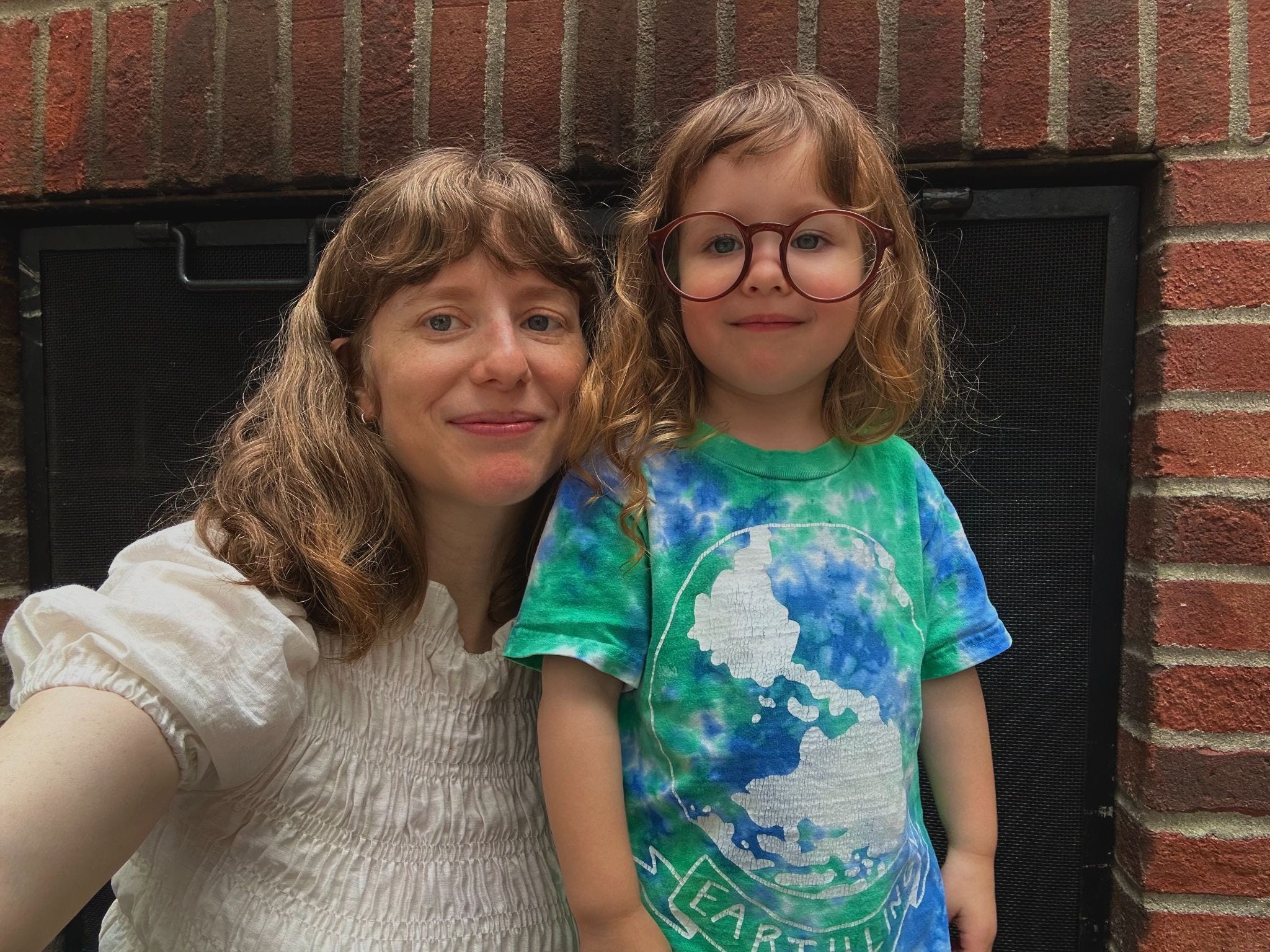
So a third dimension enters the chat: I think I also bristled at the questions because, currently, I relate to them viscerally. My concerns may take a slightly different shape, but the emotional core is familiar: The attentional demand of pregnancy and postpartum is intense and destabilizing. It asks a lot of us, and costs something, too. The letter writers can see this coming. The question, then, isn’t whether this focal shift involves sacrifice, or whether the sacrifices can be avoided—that’s an unequivocal yes and no—but whether we can allow ourselves this elasticity. Whether we can resist moralizing the frame, accept it as temporary and necessary, and through that acceptance discover what it offers.
Zooming in doesn’t necessarily suit my nature. I’ve long entertained a kind of fetish for perspective, believing I was better off—and a better person—the wider and more expansive my view. One of my earliest memories of “feeling mature” was when my parents didn’t let me go to a bonfire with my friends as a young teen and I neutralized my disappointment by reassuring myself I wouldn’t care in a month. Miraculously, this trick of perspective worked, and became a load-bearing pillar of my personality. In hindsight, wallowing over a missed bonfire at 14 would have been perfectly appropriate. It might have granted me a certain presence.
There are plenty of life experiences, I think, during which contracting your perspective is the only way to participate fully: falling in love, breaking up, grieving a loved one, studying for finals, writing a book, learning a skill, navigating a crisis. There were years in my early twenties where I scarcely thought about anything other than “who I was going to be,” and while that would be inexcusable now, it was appropriate then. Broadening our attention is easily considered virtuous, but a narrow focus isn’t always a failure of imagination. It can signal immersion, commitment, surrender. We need all modes of being.
Before Tavi suggested Rachel Aviv’s new book, I might have resisted reading it, reasoning I needed to think less about mothers and daughters rather than more. Not to oversell the gesture, but in picking it up, I was reminded of the vitality that becomes available when you stop fighting yourself. Ironically, then, my resentment of the mother frame was a framing issue. In motherhood, as in any experience that asks us to commit and consolidate parts of ourselves we might rather protect and diversify, consenting to the experience can offer its own kind of freedom. I’d like to try to revel in it before, inevitably and mercifully, it’s time to move on.

Hope you have a nice Sunday,
Haley
you've mentioned feeling self conscious about motherhood content before, but i wonder how many of your readers are 1) mothers or 2) interested in becoming a mother one day or 3) not interested in becoming a mother themselves, but are curious to understand more about the experience. this poll is probably too prying to run and won't be as novel as the clean sheets debate lol, but i reckon a majority of your readers would fit into one of these buckets. not that you are doing this, but i hate the thought that you might be censoring your experience or art to try and appeal to the most readers. we pay to be here because we love your writing, and that is your art, and the most compelling work comes from what feels most true to the artist. ignore this comment if none of it resonates, but i just want to ensure you feel supported by us (been a paying sub for a long time so feel justified to speak on behalf of all the readers lol) to share what feels most authentic to you.
p. s. i found myself thinking "what stroller is hayley going to get for 2 kids?" because i remember your qualm with the yoyo not having enough storage and i thought wow i hope she gets the uppababy vista of her dreams lol so pls report back with your double stroller choice.
Love this ❤️ I agree that fighting to hold on to “your old self” makes becoming your new parent self harder, and almost denigrates the role of being a mother. Everything got easier for me when I let that go.
I loved the book Matrescence by Lucy Jones. It’s essentially about how much you biologically and psychologically transform when becoming a mother, and makes an excellent point about how we make so much space for “coming of age” stories about adolescence in modern culture and yet seem to have so little time for stories about the experience of becoming a mother. I thought it was such a good parallel to draw - another time of having a “before” and “after” and yet we don’t expect adults to become children again after adolescence, so why do we feel so much pressure to go back to who we were before becoming mothers?
Since becoming a mother I find myself frustrated by how often the experience seems to get flattened into either “I hate being a mother - I miss who I was” or “I love being a mother - I was born to do this and never tire of it” because we don’t give it enough space or think that it’s uninteresting to talk about. For me it’s one of the most interesting things I’ve ever been through so I felt almost lied to! Now I find myself seeking out as much content as possible that dives into the nuance and complexity of it all.
Anywayyyy all this is to say I would love to hear your thoughts on Matrescence and I am here for more motherhood content!!